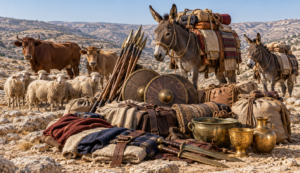

Isaac had grown old, and his eyesight had dimmed. He called his older son, Esau, and asked him to take his hunting equipment into the field. After the hunt, Esau was to prepare the food his father enjoyed and bring it to him. Isaac wanted to bless him before his death.
Rebecca overheard the conversation. While Esau was away, she instructed Jacob to bring her two young goats so she could prepare a meal for Isaac. Jacob would take the food to his father and receive the blessing. He hesitated: his brother was hairy, while his own skin was smooth. If Isaac touched him, the attempt could bring a curse instead.
Rebecca accepted responsibility and sent him to fetch the goats. She prepared the food, dressed Jacob in Esau’s garments, and covered his hands and neck with the goatskins. Jacob entered his father’s room. Isaac blessed him with dew from heaven, fertile land, and an abundance of grain and wine. The blessing intended for Esau had passed to him.
Why Isaac Wanted to Bless Esau
Reb Noson of Breslov describes the partnership Isaac envisioned. He recognized his sons’ different strengths. Jacob devoted himself to spiritual pursuits; Esau threw himself into practical, material activity. Esau could earn a livelihood and share it with Jacob, enabling his brother to devote himself to Torah and prayer.
Such an arrangement required love. Esau had to value Jacob and the life of Torah he would help sustain. His earnings could then become a means of serving Hashem.
Isaac believed that Esau’s provision of food expressed generosity and a desire to advance that purpose. Esau encouraged that impression. In reality, he sought the material blessing for his own gratification.
Rebecca understood the difference between the partnership Isaac hoped to establish and Esau’s actual intentions. She intervened so that Jacob would receive the blessing. The planned division of responsibilities depended on a willing, loving partner, and Esau had not chosen to become one.
Esau and Jacob’s Spiritual Potential
Rabbi Mendel Kessin, drawing on the Ramchal’s account of Esau’s original role, describes the brothers’ potential in terms of two spiritual tasks. Jacob was to bring holiness into the world. Esau was to confront and subdue the forces of evil. Together, these tasks would bring creation toward its intended completion.
In this explanation, Esau began with extraordinary spiritual stature. His brother’s mission did not make his own contribution insignificant. Both could have remained good children of Hashem, carrying out different responsibilities within the same divine purpose.
Esau’s eventual wickedness must therefore be distinguished from his original potential. The work entrusted to him was holy, and he had the capacity to undertake it. His failure left Jacob to confront the opposition that Esau should have subdued. The account concerns a spiritual mission far broader than providing financial support, while showing how great Esau’s lost opportunity was.
A Partner in Spiritual Greatness
Rabbi Avigdor Miller emphasizes that Esau was never condemned to wickedness from birth. He had free choice and the potential to become righteous. His strength and energy could have advanced Jacob’s mission, and supporting his brother could have brought him greatness in this world and the next.
The prophecy that the older brother would serve the younger did not deprive Esau of that choice. He could have fulfilled it willingly, as an equal partner in Jacob’s work. The eventual subservience of his descendants was a different outcome from the partnership he could have chosen.
This opportunity extends to monetary gifts that sustain Torah institutions and charitable organizations. A person who gives money to advance their work participates in its achievement. The work may already have begun under someone else’s leadership, yet the person who helps it succeed has an opportunity for spiritual greatness.
Financial support belongs within a person’s service of Hashem. Wealth is among the resources a person can dedicate to making His name great. The giver can use that money to help the leaders of the Jewish people succeed in their work of serving Hashem.
Binyamin the Righteous and the Charity Fund
The Talmud records the story of Binyamin HaTzaddik, Binyamin the Righteous, who supervised a communal charity fund.
During a year of scarcity, a mother came to him seeking help. Binyamin told her, under oath, that the charity fund contained no money. She explained that without assistance, she and her seven children would perish.
Binyamin supported them from his own funds.
Some time later, he became dangerously ill. The ministering angels pleaded before Hashem on his behalf. They addressed Hashem as Sovereign of the Universe. He had declared that anyone who preserved a single Jewish life was regarded as having preserved an entire world. Binyamin had preserved a mother and her seven children. Should someone who had sustained those lives die so young?
The decree against him was immediately torn up, and twenty-two years were added to his life.