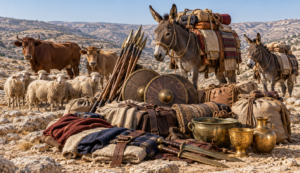

Long before the Torah was given at Mount Sinai, our forefathers observed its commandments, including the law of setting aside a tenth of what they received for giving charity.
After defeating the four kings and rescuing his nephew Lot, Abraham gave one-tenth of the spoils to Malkitzedek, the priest of the Most High. The Midrash tells us that Isaac also separated a tenth of his produce. Years later, Jacob demonstrated his observance of the Torah by promising to give a tenth of everything Hashem would grant him.
Jacob’s Promise: Giving Charity in a Time of Danger
Jacob left his parents’ home in Be’er Sheva to travel to his mother’s family in Padan Aram, where his father, Isaac, had instructed him to find a wife. His mother, Rebecca, had also urged him to leave because his brother Esau intended to kill him.
During his journey, Jacob stopped for the night and dreamed of a ladder reaching from earth to heaven, with angels ascending and descending. Hashem appeared to him and promised to remain with him, protect him wherever he went, and bring him back to the land of his fathers.
When Jacob awoke, he made a vow. He asked Hashem to protect him throughout his journey, provide him with food and clothing, and bring him safely back to his father’s home. He pledged to establish the place where he had slept as a house dedicated to Hashem and to give a tenth of everything Hashem would grant him.
Throughout the generations, Jews have continued the custom of giving charity in times of danger or distress, seeking Hashem’s salvation through the merit of this Torah commandment. The Book of Proverbs teaches that charity saves from death, and the Talmud relates incidents in which acts of charity protected people from danger. Giving charity before setting out on a journey also became a Jewish custom, accompanied by prayers for protection and a safe return.
The Jewish Charity Box: Helping the Poor in Israel
In Jewish homes throughout Eastern Europe, families kept charity boxes bearing the name of Rabbi Meir Baal Haness. They regularly set aside money to support the poor in the Land of Israel. The donations were gathered through an organized collection system and sent to Israel, generally once a year.
The custom associated with Rabbi Meir Baal Haness also included pledging money to charity during times of danger or distress while praying for Hashem’s help.
Tithing in Judaism: What Does Jewish Law Teach About Giving 10%?
The Hebrew word maaser means one-tenth. The Torah commands that portions of agricultural produce be separated for designated recipients, including the Levites and the poor. Jewish law also addresses setting aside a tenth of financial earnings for charity. Giving a fifth, or twenty percent, is considered a more generous measure.
Rabbi Yaakov ben Asher, known as the Tur, explains in his laws of charity that wealth is entrusted to us by Hashem. He writes: “Know that the wealth is not yours; it is only a deposit given on condition that you use it as the Depositor desires, giving a portion of it to the poor.” Giving a tenth acknowledges that Hashem, not our own efforts, is the source of our wealth.
Rebbe Nachman of Breslov explains that wealth can lead a person to pride, while giving charity helps soften the heart and cultivate humility. Fulfilling the commandment to regularly set aside a tenth of our earnings for charity reminds us that Hashem is the source of our wealth and cultivates humility.
Does Giving One-Tenth Bring Wealth?
The Mishnah in Pirkei Avot (3:13) records Rabbi Akiva’s teaching that “Tithes are a safeguard for wealth.” The Talmud (Taanit 9a) takes this teaching further through a conversation between Rabbi Yochanan and the young son of Reish Lakish.
Rabbi Yochanan asked the boy which Torah verse he had studied that day. The boy answered, “Aser te’aser,” meaning “You shall surely tithe,” and asked Rabbi Yochanan why the Torah repeated the word for tithing. Rabbi Yochanan explained that the repetition contains a remarkable promise: “Give a tenth so that you will become wealthy.”
The boy wanted to know how he could be certain that giving a tenth would make him wealthy. Rabbi Yochanan encouraged him to test it, but the boy immediately raised an objection. Was it not forbidden to test Hashem?
Rabbi Yochanan answered by referring to the prophet Malachi (3:10), where Hashem makes an extraordinary exception concerning tithes. Hashem Himself invites the Jewish people to bring their tithes into the storehouse and test Him, promising to open the windows of heaven and pour out abundant blessing.
Regularly setting aside a tenth or a fifth of our earnings for charity brings the blessing of wealth.