
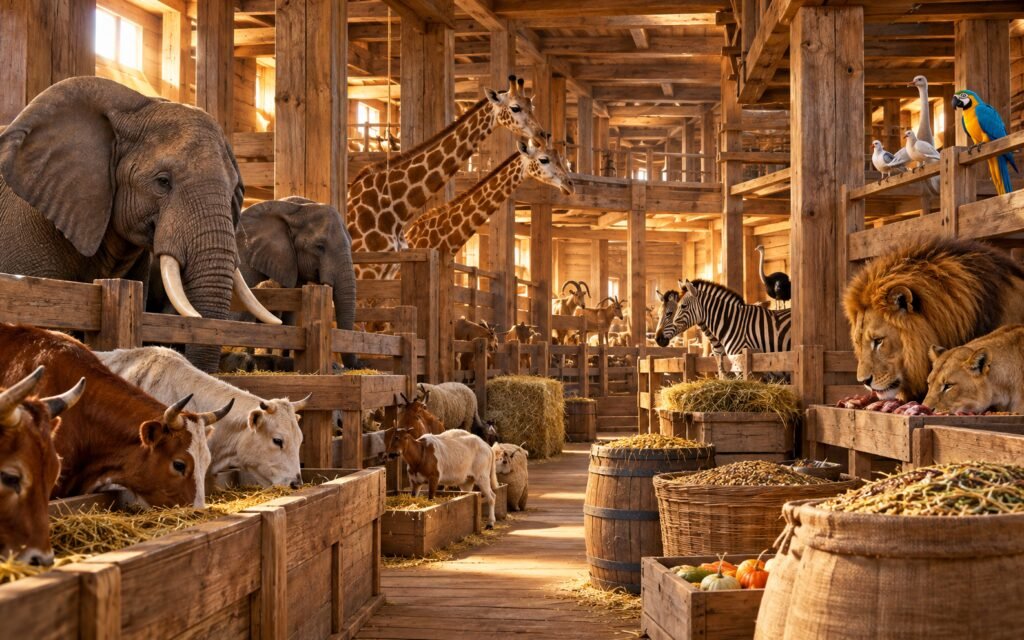
The Torah tells us that Noach found favor in the Creator’s eyes. It also calls him a tzaddik, a righteous man. What distinguished Noach was not only how he lived his own life, but how far he went to sustain the lives of others.
There is a remarkable connection between Noach and Yosef. Both are singled out in the Midrash as tzaddikim—righteous men—because they sustained others during times of extraordinary need.
Noach preserved the creatures of the world during the Flood. Yosef sustained people during a devastating famine. Neither undertaking was simple, and neither could be accomplished through an occasional act of generosity.
Noach’s Ark: Feeding the Animals Day and Night
The ark measured 300 cubits long, 50 cubits wide, and 30 cubits high. Depending on the traditional measure of a cubit, its length was approximately 144 metres or more.
It had three levels. Noach and his family occupied the upper level, the animals lived in the middle, and the bottom was used for waste.
Imagine the responsibility of feeding all those creatures.
Some animals ate during daylight. Others ate at night. Different creatures needed different foods, and Noach had to learn what each one required.
He even struggled to discover what the chameleon ate. Only after observing it catch a worm that emerged from a pomegranate did he discover how to provide for it.
With so many different feeding schedules, there was no single mealtime when Noach could finish his work and rest. When the daytime animals had eaten, the nocturnal creatures still needed attention.
And this continued for an entire year.
The demands were so great that Noach became physically ill from the strain. He groaned and spat blood. On one occasion, a lion struck him because its food had been delayed.
Even the phoenix, seeing how overwhelmed Noach was, reportedly refrained from asking him for food so as not to trouble him further.
Noach had to keep track of every creature, including those whose needs were unfamiliar to him. His responsibility continued regardless of his exhaustion.
How Yosef Sustained People During the Famine
Yosef faced a different kind of crisis.
When Pharaoh’s dreams foretold seven years of plenty followed by seven years of famine, Yosef organized a nationwide system for storing grain.
During the years of abundance, he oversaw the collection of food. When famine spread, Egypt had reserves available, and people came from surrounding lands to purchase grain.
Yosef had to administer the supplies during a prolonged emergency. This required planning years in advance, organizing storage, and managing distribution as the famine continued.
He also took responsibility for his own family.
When his father and brothers came to Egypt, Yosef provided for their households according to their needs. Even after Yaakov died, when his brothers feared revenge for having sold him into slavery, Yosef reassured them that he would continue supporting them and their young children.
He had every reason to remember what his brothers had done. Yet he chose to concern himself with their survival and their children’s welfare.
Why Noach and Yosef Were Called Tzaddikim
Noach and Yosef lived generations apart. One cared for the creatures sheltered inside an ark. The other administered food supplies for a country facing famine.
Their work required more than the ability to give. It demanded the determination to keep providing, even when the responsibility was difficult, exhausting, or prolonged.
This sheds light on the Torah’s description of Noach finding favor in the Creator’s eyes. His righteousness was not confined to personal conduct. It included the extraordinary lengths he was prepared to go to preserve life.
There is another significant detail in Yosef’s story. His brothers did not have to earn his assistance by first proving they deserved his kindness. Yosef promised to sustain them and their children despite their earlier wrongdoing.
Providing food to those who need it also appears in the Torah teachings about welcoming people in need during Sukkot.